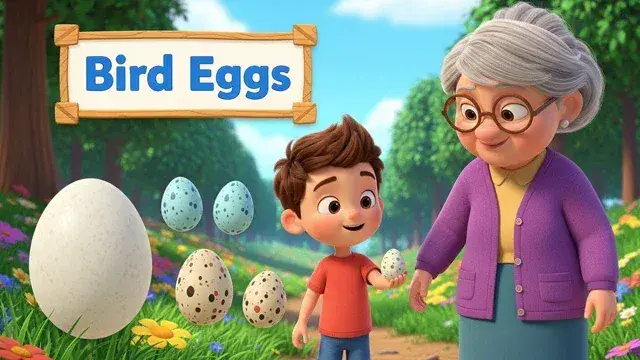
Nature's Hidden Gems – The Beautiful World of Bird Eggs
Discover nature's most beautifully hidden treasures — bird eggs! Learn about nesting, hatching and the amazing variety of eggs birds lay in this animated nature story.
About This Video
A robin's egg is the exact blue of a summer sky. A guillemot's egg is pointed at one end — so that when accidentally disturbed on a cliff ledge, it rolls in a circle rather than rolling off the edge. A cuckoo's egg is larger than usual and matches the exact colour of the host bird's eggs, fool the foster parents completely. A great tit's egg is white with rust speckles perfectly camouflaged against dead leaves in a hedgerow. This nature story explores bird eggs through the extraordinary variety of colours, patterns and shapes found in the nests of British and world bird species.
Perfect for children aged 2 to 7 who love birds or nature. In spring and summer, look for bird nests in gardens and hedges — always observe from a distance without touching. In autumn, blow a hen's egg from the kitchen and paint it as a nature craft. Free.
All videos on Little Story World are completely free — no account required, no subscription needed. Browse 120+ free animated stories, songs and science adventures for children aged 2 to 7.
Parents' Questions
What makes each bird's egg unique in colour, shape and pattern, according to this video?
This bird egg story explains that egg colour and pattern are not random decoration — each serves a survival function. The robin's sky-blue eggs blend into the shadowed hollow of a hidden nest. The guillemot's pointed egg rolls in a circle so it does not fall from the bare cliff ledge where it is laid (no nest — just the ledge itself). The cuckoo's egg matches the host species' eggs so closely that the foster parents do not notice the imposter. The lapwing's cryptically patterned egg matches bare ploughed earth so precisely that a human can almost step on the nest without seeing it.
What seasonal wildlife activity does the bird egg video inspire in spring and summer?
In spring (April to June), bird nests are occupied and eggs may be present — this is the best time to quietly observe nest sites from a respectful distance without approaching closely. Look for song thrush, blackbird, robin and blue tit nests in gardens and hedges. A bird box with a camera inside (widely available) allows children to watch the complete nesting cycle from egg to fledgling without disturbance. In autumn when nests are abandoned, you can examine them closely to understand their construction — some contain hundreds of individual pieces of grass, woven into a perfect container.
What age is the Bird Eggs and Nesting story designed for?
Designed for children aged 2 to 7. Young children are captivated by the colours — the perfect blue of a robin's egg, the speckled patterns, the surprising shapes. Children aged 5 to 7 engage with the survival function of each colour and the remarkable cuckoo story — a bird that never builds its own nest, laying its eggs in other birds' nests and leaving its young to be raised by duped foster parents. One of the most extraordinary examples of evolutionary adaptation in the British countryside, made completely accessible by this warm and visually beautiful nature story.