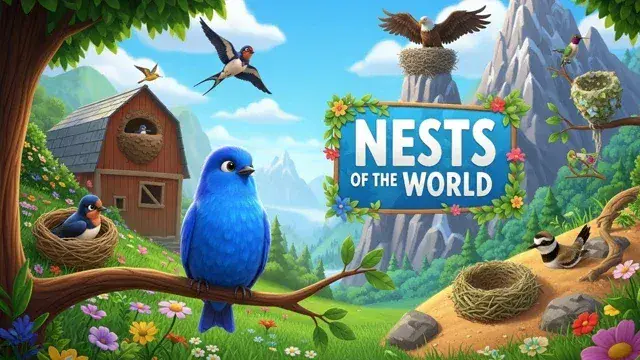
Amazing Bird Nests – Incredible Homes Birds Build Around the World
Discover the incredible nests birds build around the world! From tiny cup nests to giant eagle platforms in this wonderful animated nature story for children aged 2–7.
About This Video
A bald eagle's nest gets heavier every year — the same pair returns and adds more sticks each breeding season until the nest weighs over a tonne and is large enough to hold three adult humans. This animated nature story visits the world's most remarkable bird nests: the fairy-wren's domed grass nest, the weaver bird's intricate woven suspended nest tied to a thin branch, the bowerbird's decorated courtship structure, the swallow's mud cup plastered to a cliff, the puffin's burrow and the flamingo's mud volcano mound.
Perfect for children aged 2 to 7 who love wildlife and nature. After watching, look for real bird nests in hedges and trees in autumn when leaves have fallen. Never disturb an occupied nest — observe and photograph. Then try building a nest using only natural materials. Free to watch.
All videos on Little Story World are completely free — no account required, no subscription needed. Browse 120+ free animated stories, songs and science adventures for children aged 2 to 7.
Parents' Questions
Which remarkable bird nests from around the world does this nature video show?
This bird nest story visits: the bald eagle's platform nest (the same pair returns each year adding more sticks — one famous nest in Ohio weighed over 2 tonnes), the African weaver bird's intricate woven hanging nest (tied to a thin branch to prevent predators climbing — the male weaves and the female inspects and chooses), the cliff swallow's mud cup (built one beak-load of wet mud at a time), the burrowing puffin (nests underground in a tunnel it digs itself), and the Australian bowerbird (which builds a decorated avenue structure not as a nest but as a courtship display, decorating it with blue objects specifically).
How can children try building a bird's nest after watching this video?
Collect natural materials on a woodland walk — thin twigs, grass stalks, horse hair if found, wool from a fence, feathers, moss, damp leaves, spider silk if visible. Use only these materials and your hands to shape a cup nest strong enough to hold three eggs (you can substitute small stones for eggs). This design challenge — building something structurally sound without tools from only what you find in nature — gives children the deepest possible respect for what birds achieve instinctively with only their beaks and feet.
What age is the Amazing Bird Nests story designed for?
Designed for children aged 2 to 7. Young children are captivated by the scale contrasts — the tiny wren nest versus the enormous eagle platform. Children aged 5 to 7 engage deeply with the engineering and behaviour questions: Why does the weaver bird tie a knot? How does the swallow know when the mud is sticky enough? Autumn and early spring are ideal times to watch — then go looking for real nests in bare hedges and trees, carrying a field guide to identify which species built each one from its shape and materials.