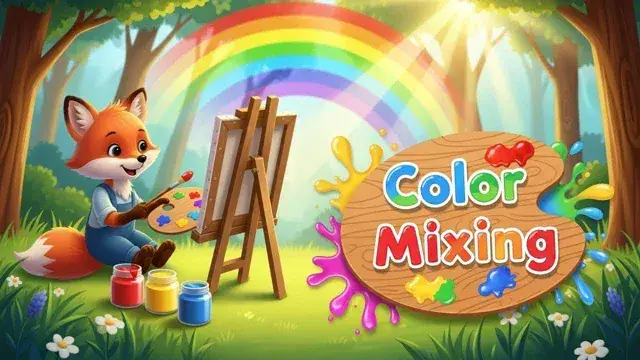
The Colour Mixing Lab – Discover Primary & Secondary Colours
Mix colours like a scientist and discover the secret of primary and secondary colours! This dazzling animated story makes colour science feel magical for children aged 2–7.
About This Video
In the laboratory, the scientist pulls on her goggles, picks up a jar of red and a jar of blue — and pours them together. Purple appears. Then yellow and blue become green. Then red and yellow create a warm, glowing orange. This animated colour mixing story shows the magic of primary and secondary colours through spectacular experiments, explains why red, yellow and blue are called primaries (you cannot mix them from other colours), and introduces the full colour wheel through the most hands-on approach there is — mixing it yourself.
Perfect for children aged 2 to 7 who love art, painting or science. The moment the video ends is the best moment to mix paints — the learning is most vivid when immediately physical. All you need is red, yellow and blue paints and a piece of white paper. Free to watch with no account needed.
All videos on Little Story World are completely free — no account required, no subscription needed. Browse 120+ free animated stories, songs and science adventures for children aged 2 to 7.
Parents' Questions
What colour mixing experiments does this animated science story show?
This colour mixing story covers all six primary-to-secondary combinations: red + blue = purple, yellow + blue = green, red + yellow = orange. Then it introduces mixing secondary colours with primaries to create tertiary colours: blue-green, yellow-green, red-orange, red-purple, blue-purple and yellow-orange. The full colour wheel is built up one mix at a time through experiments. Children can predict each result before it happens — getting the satisfaction of being scientifically right at every step through the entire wheel.
What should children do immediately after watching the Colour Mixing Lab video?
Mix paint — immediately, while the video is still vivid. Put a small blob of red, yellow and blue on a palette or old plate and mix each combination the video showed: red + blue, yellow + blue, red + yellow. Then try mixing three colours and see what happens (usually a muddy brown — another excellent discovery). Ask: 'Can we make the brightest possible orange? What happens if we add just a tiny bit of white?' For children aged 2 to 7, the physical act of mixing a new colour that did not exist before is a genuine scientific wow moment.
What age is The Colour Mixing Lab video designed for?
Designed for children aged 2 to 7. Two to four year olds are captivated by the visual magic of one colour changing into another and love the word 'purple' and 'orange' appearing from nowhere. Children aged 5 to 7 understand the primary/secondary distinction and begin working around the full colour wheel independently. The video is excellent as both an art introduction and a science activity — one of the few topics that genuinely bridges creative and scientific thinking at this age.