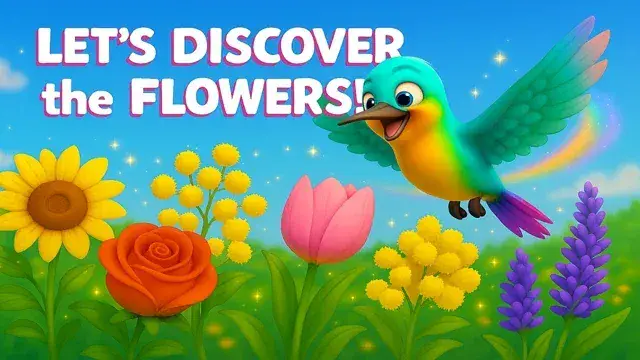
Flower Power! – A Hummingbird's Song About Beautiful Flowers
Fly along with a hummingbird and discover different flowers through song! This charming animated nature song teaches flower names and colours for children aged 2–7.
About This Video
A ruby-throated hummingbird hovers in front of a trumpet flower, its wings beating 80 times per second so fast they are a blur, its long curved beak probing perfectly into the flower's depth to reach the nectar. This garden song follows the hummingbird from flower to flower — red salvia, blue lobelia, orange nasturtium, yellow sunflower, purple lavender — naming each flower's colour, the insects sharing the garden with the hummingbird, and the special relationship between the bird and the flowers it pollinates as it feeds.
Perfect for children aged 2 to 7 who love birds, flowers or garden wildlife. After watching, plant one hummingbird-attracting flower in a pot — or attract native pollinators by planting lavender. Watching real bees and butterflies on flowers becomes vastly more interesting after learning this story. Free.
All videos on Little Story World are completely free — no account required, no subscription needed. Browse 120+ free animated stories, songs and science adventures for children aged 2 to 7.
Parents' Questions
What flowers and wildlife appear in the Hummingbird Garden Song?
This garden song follows a ruby-throated hummingbird — a real species from North America whose wings beat up to 80 times per second — through a garden in full summer bloom. Flowers visited include red salvia (shaped specifically to suit a hummingbird's curved beak), blue lobelia (beloved by bees and hummingbirds alike), orange nasturtium (whose large open flowers also attract butterflies), sunflowers (where bees spiral from the outside discs inward), and deep purple lavender buzzing with dozens of bumblebees. The garden's other wildlife includes a painted lady butterfly, a striped bumblebee and a ladybird on a lettuce leaf.
Does the hummingbird garden song explain the relationship between flowers and pollinators?
Yes — the song naturally shows the mutualistic relationship between hummingbirds and flowers: the hummingbird needs the nectar for energy to fuel its extraordinary wing beats, and the flower needs the hummingbird to carry pollen from flower to flower to create seeds. The hummingbird's long curved beak fits perfectly into trumpet-shaped flowers — not by accident but because the two species evolved together over millions of years, each shaping the other. Children who watch this video look at every flower and bee on a warm day through the lens of this relationship, making every garden a living demonstration of evolutionary biology.
What age is the Flower Power Hummingbird Garden Song designed for?
Designed for children aged 2 to 7. Young children are captivated by the hummingbird's unbelievable wing speed and the vivid flower colours. Children aged 5 to 7 engage with the pollination relationship and flower anatomy. After watching, identify pollinating insects in a real garden or park — bees, butterflies, hoverflies — and watch them move from flower to flower exactly as the hummingbird does in the song. The combination of vivid animated content and immediately observable real-world behaviour makes this one of the most transferable wildlife songs in the collection.