Where Are the Hidden Animals? – An Animal Search Challenge
Lions, rabbits, birds and frogs are hiding — can your child find them all? This exciting animated animal search game builds observation skills for children aged 2–7.
About This Video
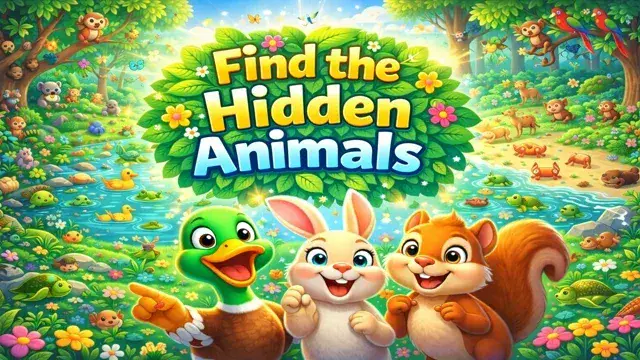
In a lush jungle scene, a chameleon is almost completely invisible against the bark of a tree. A stick insect is indistinguishable from the twig it sits on. A snow leopard's spots dissolve it into the rocky hillside. A flounder flatfish on the sandy seabed has become the sand. This search-and-find animal video turns camouflage into a game — children must find each hidden animal, learning both the fun of searching and the remarkable evolutionary reason each animal is so hard to spot in its habitat.
Perfect for children aged 2 to 7 who love animals. After watching, look up real camouflage photography online — the toad sat on a rock that looks exactly like a toad, the leaf insect that is a perfect green leaf. Camouflage is one of nature's most spectacular phenomena. Free.
All videos on Little Story World are completely free — no account required, no subscription needed. Browse 120+ free animated stories, songs and science adventures for children aged 2 to 7.
Parents' Questions
Which camouflaged animals does the hidden animals video ask children to find?
This animal hide-and-seek video features animals across multiple habitats whose camouflage makes them genuinely difficult to spot. In the jungle: a leaf-tailed gecko that looks indistinguishable from bark, a green tree python coiled around a branch that matches it exactly, a stick insect on a twig. In the Arctic: a ptarmigan that turns completely white in winter snow. In the ocean: a flounder flatfish that matches the exact colour and texture of sandy seabed, a weedy sea dragon disguised as kelp. In the savannah: a lion's golden coat in dry grass, a leopard's spots against dappled shade.
Does the hidden animals video explain why animals use camouflage?
Yes — camouflage serves two very different purposes depending on the animal. Prey animals — the chameleon, the flounder, the ptarmigan — use camouflage to avoid being seen by predators. Predator animals — the lion, the leopard, the praying mantis — use camouflage to remain invisible to prey until they are close enough to strike. The video shows both types and explains why each works in its specific habitat. Children who understand camouflage as a survival strategy begin seeing it everywhere — in moths on tree bark, frogs on pond weed, cats sleeping on patterned fabric.
What age is Can You Find All the Hidden Animals suitable for?
Designed for children aged 2 to 7. Young children love the 'aha!' moment of finding a hidden animal after searching — that instant of pattern recognition and discovery is one of the most satisfying cognitive experiences in early childhood. Children aged 5 to 7 engage with the camouflage biology as well as the game, begin predicting which environments different camouflage patterns suit and start designing their own camouflage patterns for imaginary animals in imaginary habitats — excellent creative and ecological thinking combined.