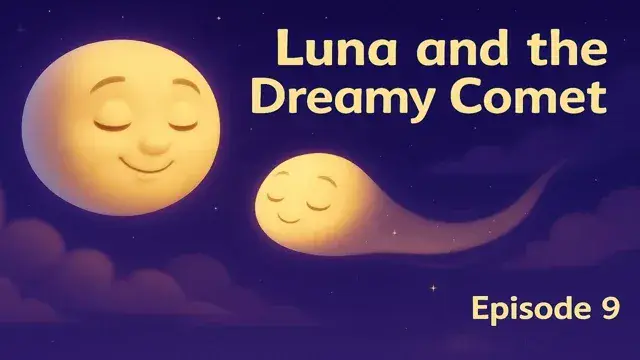
️ Riding the Dreamy Comet – Luna's Night Sky Adventure
Ride a dreamy comet across the night sky with Luna! This sparkling animated bedtime story takes children on a cosmic adventure before drifting into peaceful sleep aged 2–7.
About This Video
On the clearest night of the year, a comet appears — first as a fuzzy patch of light, then as a distinct nucleus with a luminous tail stretching away from the sun. Luna watches it move imperceptibly across the sky from her window and then — because Luna's nights have a way of becoming adventures that start at the window and end somewhere else entirely — she finds herself riding the comet's tail through the inner solar system, past the orbits of the planets, through a field of tumbling asteroids, and out toward the deep dark of the outer system where the comet was born.
Perfect for children aged 2 to 7 fascinated by space, comets or night sky adventures. After watching, look up 'comet visible tonight' online on any clear night — several comets are visible through binoculars each year. Free.
All videos on Little Story World are completely free — no account required, no subscription needed. Browse 120+ free animated stories, songs and science adventures for children aged 2 to 7.
Parents' Questions
What does Luna see on her comet ride through the solar system?
Luna's comet ride takes her through the complete inner solar system. She passes Mercury — sun-scorched, covered in craters, airless and extreme — and sees it from an angle impossible on Earth. She crosses the orbit of Venus, whose thick cloud layer reflects back so much sunlight it is the brightest object in the night sky after the Moon. She sees Earth from far away — the blue marble suspended in black space that Apollo astronauts described as both precious and fragile. She crosses the asteroid belt between Mars and Jupiter, where tumbling rocks ranging from dust-grain size to 940 kilometres across orbit in a relatively sparse ring. Then the comet turns outward toward the distant dark.
Does the comet story teach children what comets actually are and where they come from?
Yes — in the most accessible way available for young children. The story explains that comets are balls of ice and rock — sometimes described as 'dirty snowballs' — that come from the Oort Cloud at the very outer edge of the solar system, where they have floated in cold darkness for billions of years. When a gravitational disturbance sends a comet falling inward toward the sun, the sun's heat begins vapourising the ice, and the resulting gases and dust form the tail — always pointing away from the sun rather than trailing behind the comet's direction of travel, because the solar wind pushes the tail outward.
What age is Riding the Dreamy Comet Luna story designed for?
Designed for children aged 2 to 7. Young children love the visual journey — the planets passing, the asteroid belt, the comet's glowing tail. Children aged 5 to 7 absorb the comet science: where comets come from, why they have tails, why the tail points away from the sun. After watching, search 'comets visible this month' online — several bright comets pass near enough to see through binoculars each year, and the experience of pointing binoculars at a real comet in the real sky after riding it in Luna's story with a child is genuinely unforgettable.