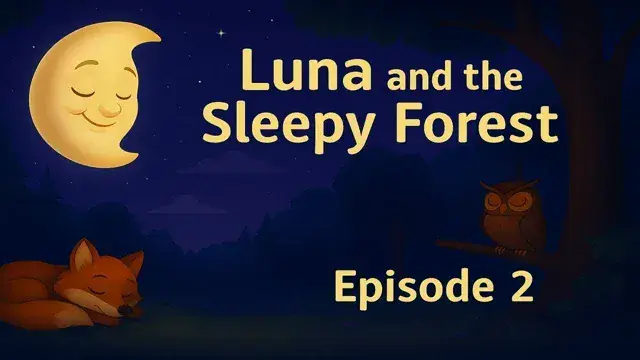
When the Forest Goes to Sleep – Luna's Quiet Night Walk
The whole forest is getting ready for sleep — and so is Luna! This quietly magical animated bedtime story celebrates the beauty of night-time for children aged 2–7.
About This Video
The forest at night is not asleep the way children are asleep — it is awake differently. The day animals have retired: the squirrels are in their dreys, the wood pigeons are silent, the bee hives are quiet. But the night shift has begun: a tawny owl calls once from somewhere very near and then moves silently on. Deer step from the treeline into the meadow they have been waiting for all day. A badger emerges from its sett and ambles along the same path it has used every night for fifteen years. Luna walks through this waking sleeping forest and understands something about which world she belongs to.
Perfect for children aged 2 to 7 who love woodland animals. After watching, plan a guided dusk walk in a local woodland or nature reserve — many wildlife organisations run badger-watching and owl-listening events in spring and autumn. Free to watch.
All videos on Little Story World are completely free — no account required, no subscription needed. Browse 120+ free animated stories, songs and science adventures for children aged 2 to 7.
Parents' Questions
Which nocturnal forest animals does Luna encounter in the sleeping forest bedtime story?
Luna's night forest walk introduces the complete nocturnal cast of a British woodland. A tawny owl announces its territory with the to-whit second half of the famous call (the wife-who answering a mate). A badger follows its invariable nightly route from sett to favourite earthworm field, the same path worn smooth by fifteen years of nightly use. A roe deer doe and her grown fawn step from woodland edge into the centre meadow. A hedgehog snuffles past Luna's feet completely focused on slug-hunting. Common pipistrelle bats flicker above the clearing. A fox watches from a distance with its characteristic amber eye-shine. Every species is named and briefly described in the story's quietly educational narrative.
Does the story explain how forest animals behave differently during the day and night?
Yes — the story makes the day-to-night transition of the forest explicit and fascinating. The same forest contains two completely different animal communities in succession: the daytime community of squirrels, woodpeckers, rabbits, bees and butterflies, and the night community of owls, bats, badgers, foxes and hedgehogs. These communities largely avoid each other not by accident but through evolved temporal partitioning — they use the same resources at different times. Children who understand this dual-community model of woodland ecology look at any woodland with twice the understanding: 'What is happening here right now? And what was happening here six hours ago?'
What age is When the Forest Goes to Sleep Luna story designed for?
Designed for children aged 2 to 7. Young children are enchanted by the idea of the forest being awake at night when they are asleep — the parallel is immediately relatable and mysteriously appealing. Children aged 5 to 7 absorb the nocturnal ecology details and begin developing genuine interest in wildlife night watches. Dusk walks in local woodlands during spring and summer offer real opportunities to see or hear several species from this story — the tawny owl, the bat and the fox are accessible with patience and the right quiet approach almost anywhere with mature trees.