Push or Pull? – Discovering the Invisible Magic of Magnets
Discover the invisible force pulling things together — magnetism! This fun animated story explains how magnets work through exciting everyday experiments for kids aged 2–7.
About This Video
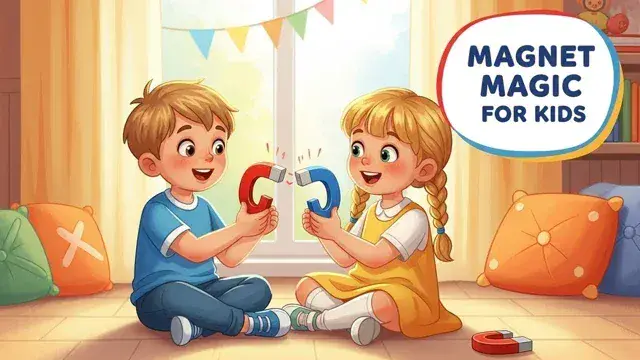
Hold two magnets with the same poles facing and feel the invisible force pushing your hands apart — push as hard as you like and the force pushes back harder. Flip one magnet over and they snap together with startling enthusiasm. This animated science story explores magnets from the inside out: what magnetic poles are, why opposite poles attract and like poles repel, which metal objects a magnet can pick up and which it ignores completely (gold and silver are not attracted), and why the Earth itself is a giant magnet with magnetic poles that guide compass needles.
Perfect for curious children aged 2 to 7. A bar magnet and a collection of household objects gives children enough to investigate for an entire afternoon. Sort objects into magnetic (iron, steel) and non-magnetic (plastic, wood, copper, aluminium). Free to watch.
All videos on Little Story World are completely free — no account required, no subscription needed. Browse 120+ free animated stories, songs and science adventures for children aged 2 to 7.
Parents' Questions
What does the Push or Pull magnets story teach children about magnetic attraction and repulsion?
This magnet science story explains the two poles of every magnet — north and south — and the rule that opposite poles attract (north attracts south, south attracts north) while like poles repel (north pushes north away, south pushes south away). Children can feel this invisible force physically in their hands when holding two magnets together — and the feeling of that repulsive force pushing two magnets apart with no visible means is one of the most viscerally astonishing physical experiences available to any young scientist. The story also explains that the Earth is itself a giant magnet, which is why a compass needle always points north.
What magnet investigation should children try after watching the Push or Pull video?
Collect 15 to 20 household objects — a paperclip, a coin, a piece of aluminium foil, a wooden spoon, a steel spoon, a plastic button, a gold earring, a piece of copper wire, a steel nail, a rubber band. Test each with a magnet and sort them into two groups: attracted (magnetic) and not attracted. Children discover that iron and steel are strongly magnetic while copper, aluminium, gold, silver, plastic and wood are not — and that 'metal' does not automatically mean 'magnetic'. This single investigation dismantles a very common misconception while being thoroughly enjoyable to conduct.
What age is the Push or Pull magnets science story designed for?
Designed for children aged 2 to 7. Two to four year olds are captivated by the snap-together attraction and the push-apart repulsion — both force experiences are visceral in the hands and genuinely astonishing the first time. Children aged 5 to 7 classify objects as magnetic or non-magnetic independently and begin asking: 'How do magnets work inside?' 'Can you make a stronger magnet?' 'Why does the compass needle always point north?' These are genuinely important physics questions that this video is designed to make children urgently want to answer.