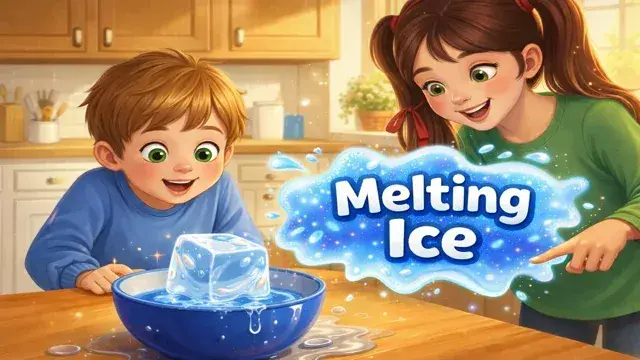
Why Does Ice Melt? – Discovering States of Matter for Kids
Watch ice melt, flow and transform in this cool animated science experiment! Discover solid, liquid and gas in a fun, accessible story perfect for curious kids aged 2–7.
About This Video
Take a solid ice cube, leave it in a warm room and it becomes liquid water. Put that water in a freezer and it becomes ice again. Heat the water and invisible steam rises into the air. This science story shows children the three states of matter — solid, liquid and gas — through the journey of water as it transforms from ice cube to puddle to invisible vapour and back again, explaining why temperature is the switch that changes everything.
Perfect for curious children aged 2 to 7 who notice water everywhere — puddles evaporating on sunny days, frost on cold windows, ice in drinks. All the concepts in this video can be tested safely at home with ice and a glass of warm water. Free to watch with no account needed.
All videos on Little Story World are completely free — no account required, no subscription needed. Browse 120+ free animated stories, songs and science adventures for children aged 2 to 7.
Parents' Questions
What are the three states of matter that this ice melting video teaches?
This science video introduces solid (ice: water frozen in a fixed shape), liquid (water: flows and takes the shape of any container) and gas (water vapour: invisible, spreads to fill any space). Children see water move between all three states driven purely by temperature. Ice melts in warm hands because body heat transfers energy into the ice. Liquid water evaporates in sunshine. Water vapour condenses on a cold glass. By the end, children understand that 'ice', 'water' and 'steam' are the same substance in different forms.
What melting and freezing experiments can children try after watching this video?
Place identical ice cubes in three locations — a sunny windowsill, a shaded cool room and a bowl of warm water — and predict which will melt first. Time each one and compare. Then look for real examples of the water cycle at home: a cold glass beading with condensation, a mirror fogging after a bath, a puddle disappearing on a sunny day. Each is a real-world state-of-matter example that connects directly to what the video explained about ice, water and vapour.
What age is the Why Does Ice Melt states of matter video designed for?
Designed for children aged 2 to 7. Two to four year olds love the visual of ice changing in a warm hand — it is magic-like and deeply satisfying. Children aged 5 to 7 grasp solid, liquid and gas as a scientific concept and can explain why ice melts and puddles evaporate. The melting ice experiment is one of the most popular first science activities for young children — safe, free, requires only ice and curiosity, and delivers immediate, visible results.