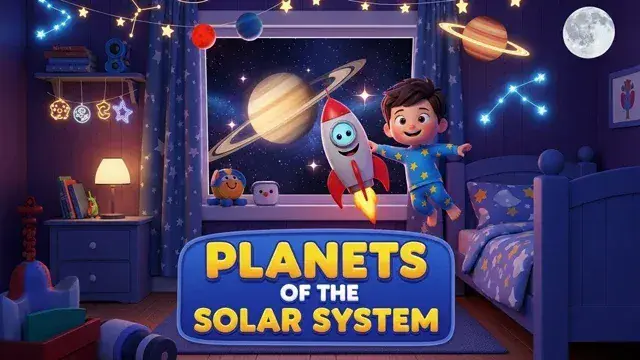
Our Amazing Solar System – Explore the Eight Planets for Kids
Blast off on a journey through our solar system! Discover all eight planets, the Sun and the Moon in this spectacular animated space story for curious kids aged 2–7.
About This Video
At the centre of our solar system is a star so large that 1.3 million Earth-sized planets could fit inside it — and eight planets journey around it in their own oval paths called orbits. This animated space story introduces all eight planets from closest to furthest: tiny rocky Mercury, cloud-covered Venus, our blue-green Earth, red dusty Mars, enormous Jupiter with its Great Red Spot storm, ringed Saturn, tilted Uranus, and distant Neptune with winds of 2,000 kilometres per hour. Each planet is given its own personality, colour and remarkable fact.
Perfect for children aged 2 to 7 fascinated by space, stars or the night sky. After watching, look for visible planets with a free star-finding app on a clear night — Venus, Jupiter and Saturn are often visible to the naked eye. Free to watch with no account needed.
All videos on Little Story World are completely free — no account required, no subscription needed. Browse 120+ free animated stories, songs and science adventures for children aged 2 to 7.
Parents' Questions
What facts does the solar system story teach children about each of the eight planets?
This space story gives children a memorable fact for every planet: Mercury (the fastest planet — a year lasts only 88 Earth days), Venus (the hottest planet despite not being closest to the Sun — its thick atmosphere traps heat to 465 degrees Celsius), Earth (the only planet with liquid water on the surface and the only confirmed location of life in the universe), Mars (home to Olympus Mons — the solar system's largest volcano, three times the height of Everest), Jupiter (the Great Red Spot is a storm larger than two Earths that has been raging for at least 350 years), Saturn (its rings are made of ice and rock debris), Uranus (rotates on its side), Neptune (fastest winds in the solar system).
How can this solar system video inspire real-life stargazing with young children?
Several planets are visible to the naked eye on clear nights and are significantly brighter than any star. After watching, download a free star-finding app and step outside on a clear night — point the phone at the brightest object in the sky and see if it is Venus, Jupiter or Saturn. Planets do not twinkle like stars because they are close enough to show as tiny discs rather than points of light. For children aged 2 to 7, the moment of pointing at a bright object in the real sky and knowing its name from the video is one of the most memorable early space science experiences possible.
What age is Our Amazing Solar System space story designed for?
Designed for children aged 2 to 7, though solar system enthusiasm continues well past age 12. Young children love the visual drama of the planets — Saturn's rings, Jupiter's swirling red storm, Earth glowing blue-green from space. Children aged 5 to 7 memorise the planets in order and begin asking the deeper questions that define scientific thinking: 'Could anything live on Mars?' 'How long would it take to travel to Neptune?' 'What is beyond the edge of the solar system?' Starting those conversations is the video's most important purpose.