Roll, Spin and Slide! – The Physics of Moving Objects for Kids
Roll, spin and discover the physics of movement in this lively science story! Learn about gravity, friction and why round objects roll — fun hands-on science for kids aged 2–7.
About This Video
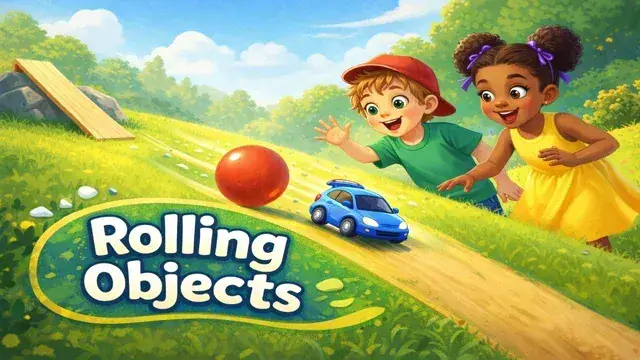
Why does a ball roll but a cube slide? Why do objects move faster on a smooth surface than a rough one? This lively science story tests different shaped objects — spheres, cylinders, cubes and cones — on ramps at different angles, discovering the forces of gravity, friction and momentum through action. The video turns the physics of everyday movement into a series of exciting predictions and discoveries that children can immediately test with objects found at home.
Great for curious children aged 2 to 7 who love ramps, rolling and moving things. All the experiments in the video can be recreated with a stack of books as a ramp and household objects. Used widely in nursery and school science exploratory sessions. Free to watch any time.
All videos on Little Story World are completely free — no account required, no subscription needed. Browse 120+ free animated stories, songs and science adventures for children aged 2 to 7.
Parents' Questions
What physics concepts does Roll, Spin and Slide explain to children?
This science video covers gravity (the force that pulls objects down the ramp), friction (the roughness of surfaces that slows or stops things moving), and momentum (the tendency of a moving object to keep moving). Children see why round objects roll while flat-bottomed ones slide, why the same ball moves faster on a smooth wooden floor than on carpet, and why a heavier object does not necessarily roll faster than a lighter one — a genuine surprise that most adults also find fascinating when they test it.
What rolling and ramp experiments can children try after watching this video?
Build a ramp from a piece of cardboard or a plank leaned against a stack of books. Test a ball, a marble, a cardboard tube, a block and a coin. Before each test, ask your child to predict which will reach the bottom first and why. Change the ramp angle and compare results. Try the same objects on a smooth table surface versus a carpet. For children aged 2 to 7, this simple, free experiment set creates exactly the motivated scientific testing that this video is designed to inspire.
What age is Roll, Spin and Slide physics video suitable for?
Designed for children aged 2 to 7. Young children aged 2 to 4 are captivated by the sheer excitement of things rolling and crashing at the bottom. Children aged 5 to 7 begin making and testing predictions about which object will move fastest and why — developing the prediction-test-result scientific thinking that underpins all future science. The video is used in nursery and school physics exploratory sessions and is one of the easiest science videos to turn into an immediate hands-on investigation.