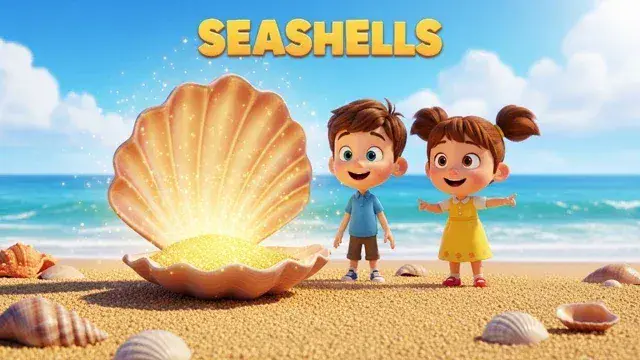
Treasures from the Sea – Discovering the Secret Lives of Seashells
Collect beautiful seashells on an animated ocean treasure hunt! Learn about molluscs and the amazing variety of ocean life in this captivating nature story for kids aged 2–7.
About This Video
Every shell on a beach was once someone's home. This animated nature story explores the world of molluscs — the ocean animals that build their own homes from calcium carbonate secreted through their body — and the astonishing variety of shells they produce. Children encounter whelks with their spiral staircase architecture, smooth oval cowries used as currency across the ancient world, fan-shaped scallops that can swim by clapping their shells, flat limpets that cling to rocks with more force per square centimetre than almost any natural adhesion, and razor clams that live buried vertically in sand.
Perfect for children aged 2 to 7 who have visited or will visit a beach. Bring a bucket and magnifying glass to any beach and collect a variety of shells — then use this video to identify each one. Start a labelled shell collection. Free to watch with no account needed.
All videos on Little Story World are completely free — no account required, no subscription needed. Browse 120+ free animated stories, songs and science adventures for children aged 2 to 7.
Parents' Questions
Which seashells does the Treasures from the Sea story introduce to children?
This seashell nature story introduces the most commonly found British coastal shells with the stories of the animals that made them. The common whelk (a large edible snail whose empty spiral shells often contain hermit crabs). The common limpet (the champion of grip — clings to rocks with a force equivalent to 75 times its own body weight). The razor clam (lives buried vertically in sand, can dig down faster than a person can dig to catch it). The cockle (filter feeds buried in sand and estuary mud). The scallop (can escape predators by clapping its shells together and swimming in short bursts). The periwinkle (grazes on green algae on rocks at the water's edge).
How can children start a seashell collection after watching this ocean story?
Visit a beach with a bucket and magnifying glass and collect 10 to 15 different shell varieties — as much variety of shape, colour and size as possible. At home, rinse each carefully, lay them on a white surface and examine with the magnifying glass. Many shells reveal intricate patterns and colour that are invisible when wet. Try to identify each shell using the video as a reference and add one later using a pocket field guide. Label each shell with a small paper tag noting where it was found. The process of building and labelling a collection develops systematic scientific thinking alongside aesthetic appreciation.
What age is the Treasures from the Sea seashells story designed for?
Designed for children aged 2 to 7. Young children love the sheer variety of beautiful shapes — the smooth cowrie, the perfect spiral whelk, the fan-shaped scallop. Children aged 5 to 7 are fascinated by the stories of the animals and the remarkable engineering of each shell's specific design. One of the most popular pre-beach-visit videos in the collection — children who have watched it arrive at any beach gravitating toward the strand line where shells collect, turning a seaside run into a focused natural history collection activity.