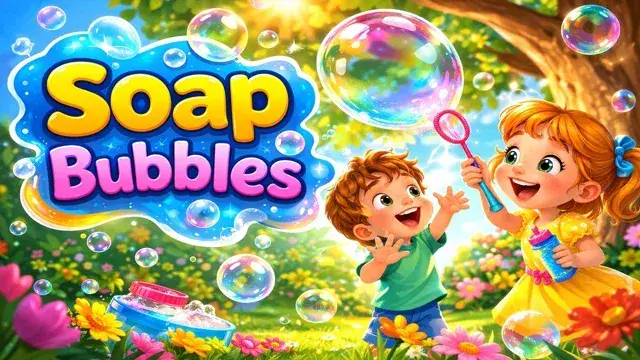
The Science of Soap Bubbles – Why Are They Always Round?
Discover the incredible science hiding inside every soap bubble! Find out why bubbles are always perfectly round in this dazzling animated science story for kids aged 2–7.
About This Video
Blow a soap bubble and it is always a perfect sphere — no matter what shape the wand is. This science story reveals why: the thin film of soapy water pulls inward equally in every direction, and the shape that uses the least surface area for any given volume of air is always a sphere. Children discover why bubbles are round, why they are iridescent, why two bubbles merge into a flat wall where they meet, and why a bubble always pops when something dry touches it.
Perfect for curious children aged 2 to 7 who love blowing bubbles. The science in this video can be tested immediately — make bubbles at home and try blowing them through a square wand to see if the bubble comes out square. Spoiler: it does not. Used in science and STEM discovery sessions. Free to watch.
All videos on Little Story World are completely free — no account required, no subscription needed. Browse 120+ free animated stories, songs and science adventures for children aged 2 to 7.
Parents' Questions
Why are soap bubbles always round, and does this video explain it clearly for kids?
Yes — this is exactly what the video explains, and it does so brilliantly. The soapy water film contracts inward pulling on every point of the bubble's surface equally. The only shape where every point on the surface is the same distance from the centre is a sphere — so a sphere is what nature always produces, regardless of the shape of the wand. Children find this deeply satisfying: the universe follows a rule, and they now know the rule. Blow bubbles through a square wand and ask your child to predict the shape — they will confidently say 'sphere' and be right.
What bubble experiments should children try after watching the soap bubble science video?
Make a thick bubble mixture at home: mix three parts water, one part washing-up liquid and a small squirt of glycerin. Try blowing very large bubbles gently. Blow two bubbles that touch and watch the flat wall form where they meet. Dip a finger into the bubble mixture and then touch a bubble to see what happens (nothing — wet things don't pop the film). Then touch a dry finger to the bubble and watch it vanish instantly. Each experiment tests a concept directly from the video.
What age is the soap bubbles science video designed for?
Designed for children aged 2 to 7, though the bubble experiments it inspires work brilliantly up to age 10 and beyond. Two to four year olds are captivated by the visual magic of bubbles and understand that bubbles are always round. Children aged 5 to 7 grasp the surface tension explanation and love testing it with their own experiments. One of the most immediately actionable science videos — children want to make bubbles within minutes of watching ending.