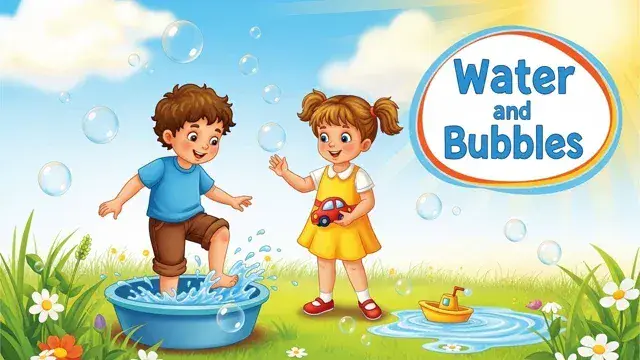
Water, Bubbles & Science! – Fun Experiments for Young Explorers
Plunge into the bubble-filled world of water science! Discover surface tension and fascinating water experiments in this colourful animated story for kids aged 2–7.
About This Video
Water is the strangest and most important substance on Earth — and this science story explores its most surprising secrets. Why does water form perfect round drops on a waxy leaf but spread flat on a paper towel? Why does a needle float on still water if placed carefully? Why does a drop of food colouring placed in a glass of water slowly spread to fill the whole glass in patterns of extraordinary beauty? Each curiosity in this story is an experiment children can try safely at home within minutes of watching.
Perfect for curious children aged 2 to 7 who love hands-on science. All experiments require only water, a waxy leaf or coin, food colouring and washing-up liquid. Set up a water investigation table immediately after watching. Free to watch with no account needed.
All videos on Little Story World are completely free — no account required, no subscription needed. Browse 120+ free animated stories, songs and science adventures for children aged 2 to 7.
Parents' Questions
What water science experiments does this video show and explain for kids?
This water experiments story covers surface tension (a needle or paper clip laid flat on still water floats because surface tension acts like an elastic skin across the water surface), hydrophobia (water beads on a waxy leaf or a duck's oiled feathers but soaks into paper — the video shows the exact moment the bead forms and rolls off a leaf), capillary action (water climbing upward through a thin tube or the fibres of a kitchen towel through pressure difference), and the soap plate trick (black pepper floating on water rushes to the edges immediately when a drop of washing-up liquid touches the centre — soap breaks the surface tension).
Which water experiment should children try first after watching this science video?
The soap and pepper experiment is the most spectacular easy experiment in this story. Fill a wide, flat plate with water. Shake a small amount of black pepper across the entire surface so it floats uniformly. Then dip a fingertip into washing-up liquid and touch the centre of the water surface. The pepper rushes to the edges of the plate instantly — as if you have said 'get away from me!' to it. The surface tension in the undisturbed areas on the edges pulls everything outward as the soap destroys it in the centre. Children aged 2 to 7 find this experiment absolutely astonishing and immediately want to reset it and try again.
What age is the Water, Bubbles and Science video designed for?
Designed for children aged 2 to 7. The visual experiments are captivating at any age — the food colouring diffusing through water in slow-motion patterns is hypnotic even for adults. Children aged 5 to 7 begin predicting: 'What will happen if I put two drops of different colours in at the same time?' 'Will a drop of oil spread on water the same way food colouring does?' These follow-up investigations can continue for an entire afternoon. Water science requires no specialist equipment and is one of the safest, most accessible and most endlessly fascinating areas of early science exploration.