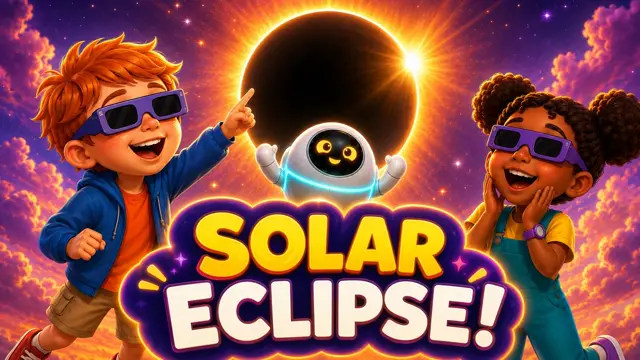
When Day Turns to Night – Solar Eclipse Explained for Kids
How does the Moon cover the Sun in broad daylight? Discover total, partial and annular solar eclipses in this clear animated space science adventure for kids aged 2–7.
About This Video
Imagine playing outside on a bright sunny afternoon when the sky slowly dims into twilight and a glowing ring appears where the Sun used to be! This clear, wonder-filled space science adventure takes young explorers into our solar system to see exactly how the Moon passes between the Earth and the Sun to create a solar eclipse.
Using simple visual models and friendly animation tailored for children aged 2 to 7, the video explains total, partial and annular ('ring of fire') solar eclipses without confusing jargon. After watching, grab a torch, a tennis ball and a football in a darkened room to recreate your own tabletop solar eclipse at home! Free to watch with no account needed.
All videos on Little Story World are completely free — no account required, no subscription needed. Browse 141+ free animated stories, songs and science adventures for children aged 2 to 7.
Parents' Questions
How does this video explain a solar eclipse to young children?
Instead of abstract astronomy terms, the video shows the Sun, Moon and Earth from space so children can watch them line up in a straight path. Children see how the smaller Moon, because it is much closer to Earth than the giant Sun, casts a travelling shadow onto Earth's surface. It also visually compares three real eclipse types — a total solar eclipse where day briefly turns dark, a partial eclipse where the Sun looks like a crescent biscuit, and an annular eclipse that leaves a bright 'ring of fire'.
Can we recreate the solar eclipse model at home after watching?
Yes — it makes one of the easiest and most memorable five-minute kitchen science experiments! Shine a torch (the Sun) toward a large ball or globe (the Earth) and let your child hold a smaller ball (the Moon) between them. As they move the small ball closer or slightly higher, they will watch a neat round shadow travel across the 'Earth' — demonstrating total, partial and annular alignments with their own hands. Always remind children never to look directly at the real Sun without certified eclipse glasses.
What age is Solar Eclipse Explained for Kids designed for?
Designed for curious minds aged 2 to 7. Three and four year olds grasp the core big idea — that the Moon moves in front of the Sun and makes a shadow, rather than the Sun 'going out'. Children aged 5 to 7 love learning the real scientific names (total, partial and annular) and understanding why eclipses only happen when the Moon's orbit lines up just right.