What Is Sound? – Discovering Vibrations & How We Hear
Discover the invisible world of sound and vibration in this fascinating animated science story! Learn why things make noise and how our ears work — for kids aged 2–7.
About This Video
When a drum is struck, the drumhead vibrates — moving back and forth many times per second — and each vibration pushes the surrounding air molecules, which push the next ones, which push the next, carrying the disturbance all the way to your eardrum. This science story makes invisible sound waves visible through animations that show the compression waves rippling outward, explains why higher-pitched sounds vibrate faster, why sounds get quieter with distance, and how the remarkable machinery of the inner ear converts vibrations into the signals the brain understands as music, speech and birdsong.
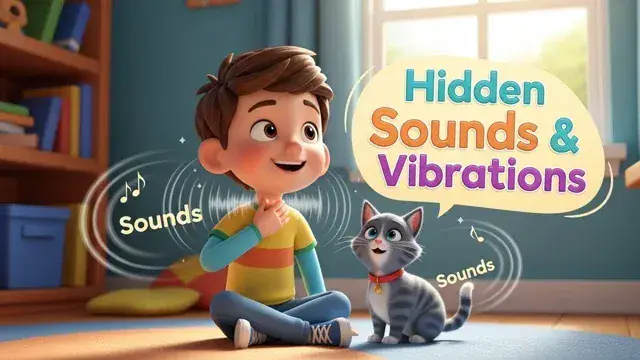
Perfect for children aged 2 to 7 who love music, instruments or simply making noise. All the sound concepts in this video can be felt directly — feel your throat vibrate when you hum, watch a rice-covered drum skin jump when you clap nearby. Free to watch with no account needed.
All videos on Little Story World are completely free — no account required, no subscription needed. Browse 120+ free animated stories, songs and science adventures for children aged 2 to 7.
Parents' Questions
How does sound travel from its source to our ears, according to this science video?
This video shows sound as a chain reaction in air. When something vibrates — a guitar string, a bell, a vocal cord — it pushes the surrounding air molecules. Those molecules bump into the next ones, which bump the next, creating a wave of pressure that travels outward in all directions at about 340 metres per second. When that pressure wave reaches your eardrum, the eardrum vibrates at exactly the same frequency as the original vibration — and tiny bones in your middle ear carry that vibration to the cochlea where it becomes the electrical signal your brain hears as sound.
What hands-on sound experiments can children do after watching the vibrations video?
Hold the back of your hand against your throat and hum — feel the vibration. Pluck a rubber band stretched between your thumbs and watch it vibrate. Place a few grains of rice on a drum and clap close to it — the rice jumps from the sound waves without being touched. Fill glasses with different amounts of water and tap each with a spoon — the less water, the higher the note (shorter vibrating water column). Each experiment connects directly to what the video explained about vibration, frequency and pitch.
What age is the What Is Sound vibrations science story designed for?
Designed for children aged 2 to 7. Two to four year olds love the drumming, the feeling of vibration in their own throats and the rice-jumping experiment. Children aged 5 to 7 grasp the wave concept and the pitch-frequency relationship, and begin listening to music with different attention — noticing high and low notes and connecting them to fast and slow vibrations. One of the most immediately testable science videos in the collection — every concept can be felt and observed within minutes of watching ending.