Why Does the Sky Turn Pink? – The Science of Sky Colours
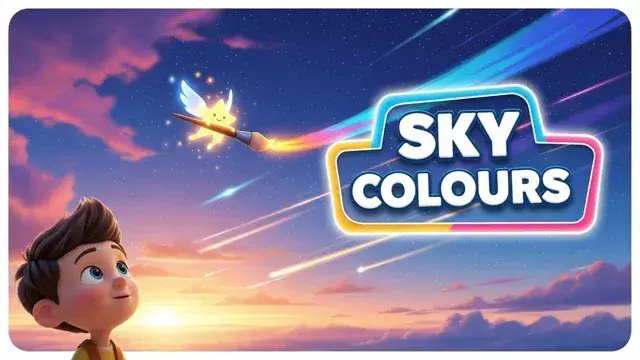
Why does the sky turn pink and orange at sunset? Discover the science of sky colours in this beautiful animated story for naturally curious children aged 2–7.
About This Video
At midday the sky is blue. At sunset the same sky blazes orange, pink and deep red. This science story reveals why: sunlight is made of all rainbow colours mixed together, and the Earth's atmosphere scatters them differently depending on the angle. When the sun is overhead, only short-wavelength blue light scatters widely across the whole sky — making it look blue. At sunset, sunlight travels through much more atmosphere, the blue scatters away entirely, and only the long-wavelength reds and oranges reach your eyes to create the spectacular display.
Perfect for curious children aged 2 to 7 who have ever looked at a sunset and asked why the sky changes. After watching, plan to watch at least one sunset together — look for which colours appear first, which last, and whether the exact colours match the science the video explained. Free.
All videos on Little Story World are completely free — no account required, no subscription needed. Browse 120+ free animated stories, songs and science adventures for children aged 2 to 7.
Parents' Questions
Why does the sky look blue in the daytime but red and orange at sunset?
This is exactly what the video explains in the most child-friendly way possible. Sunlight entering the atmosphere is actually a mixture of every colour in the rainbow. The atmosphere scatters short-wavelength light (blue) far more than long-wavelength light (red and orange). During the day with the sun overhead, this scattered blue light fills the whole sky — so the sky looks blue. At sunset, sunlight travels through a much longer diagonal stretch of atmosphere to reach your eyes. Almost all the blue has scattered away by the time it arrives, leaving only the spectacular reds and oranges of a beautiful sunset.
How can watching sunsets become a science observation activity for young children?
On a clear evening, watch the sunset together and treat it as a scientific observation. Ask: 'Which colour appeared first as the sun got low?' 'Can you see any green or purple near the horizon?' (Green flash is rare but real — a brief flash of green just as the sun dips below the horizon.) 'Which direction is the pink sky — toward the sun or the opposite horizon?' Sunsets on the opposite horizon from the sun are often the most spectacular because that is where scattered light travels. For children aged 2 to 7, the sky becomes a daily, free science show once they understand what they are watching.
What age is Why Does the Sky Turn Pink sunset science story suitable for?
Designed for children aged 2 to 7. Young children simply marvel at the colours and look for their favourite pink and gold. Children aged 5 to 7 grasp the scattering explanation and begin predicting: 'If there are lots of clouds tonight, will the sunset be more spectacular or less?' (Usually more — clouds catch and reflect the colours dramatically.) One of the most transferable science videos we make: its payoff — a spectacular sunset — is available to every child every day for the rest of their lives.