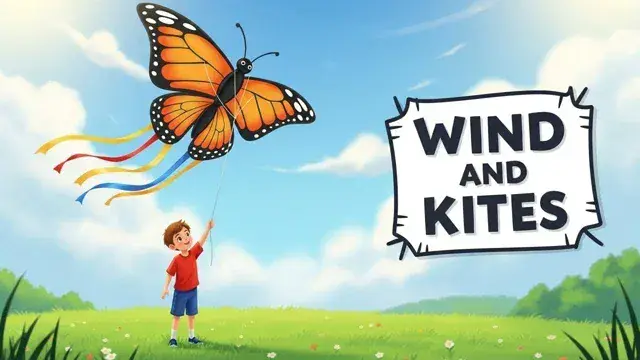
Chase the Wind! – The Science Behind Kites & Air Movement
Send a kite soaring and discover the science of wind! An exciting animated story that explains air movement and lift through the joy of kite flying — for kids aged 2–7.
About This Video
The perfect kite-flying day needs three things: an open space, a steady wind and someone who knows to keep running until the kite is high enough to catch its own wind. This science story follows a family learning to fly a kite for the first time — the frustrating launches that go nowhere, the exhilarating moment the kite finally catches the wind and climbs, and the discovery that the angle of the string, the tail's weight and the wind's steadiness all matter. Along the way, children learn about the invisible force of air and why the kite stays up.
Perfect for curious children aged 2 to 7 who love outdoors and science. A simple kite can be made from a plastic bag, two sticks and string in fifteen minutes — and flying it immediately tests everything the video explains about lift, drag and tail weight. Free to watch.
All videos on Little Story World are completely free — no account required, no subscription needed. Browse 120+ free animated stories, songs and science adventures for children aged 2 to 7.
Parents' Questions
What air and force science does the kite flying video explain to young children?
This kite story explains three invisible forces that work together to keep a kite airborne. Gravity pulls the kite downward. Wind provides lift — the moving air flows faster over the curved upper surface of the kite than the flatter under-surface, creating lower pressure above and higher pressure below which pushes the kite up. Drag (air resistance) works against the kite's movement through the air. The tail adds weight to the bottom to keep the kite stable and prevent tumbling. Children who understand these three forces notice them whenever anything moves through air — a leaf, a balloon, a paper aeroplane.
How can children make a simple kite to test the science from this video?
Make a basic kite from a large plastic bag cut open, two thin garden sticks taped in a cross pattern inside, and string attached to the crossing point at the right angle. Add crepe paper strips as a tail. Test it on a windy day — adjust the tail length until it flies stably. If it spins, add more tail. If it pulls straight down, cut the tail shorter. If it will not lift, run faster into the wind. Each adjustment is a genuine physics experiment that teaches cause and effect through direct physical action and observation.
What age is the Chase the Wind kite flying science story designed for?
Designed for children aged 2 to 7. Young children love the pure physical joy of running with a kite and feeling the string pull in their hands. Children aged 5 to 7 engage with the science — why does the kite need a tail? What happens if you make the tail shorter? Can you feel the difference between a strong gust and a gentle steady wind in the string's tension? One of the most immediate, physical, outdoor science activities available: the experiments begin the moment you step outside, and the kite does not care how old the scientist holding it is.