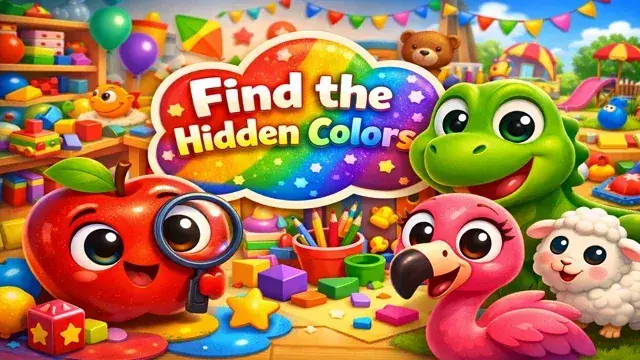
Spot All the Hidden Colours! – A Colourful Visual Search Game
Red, blue, green and yellow are hiding all around! Can your child spot every hidden colour? This vibrant animated search game makes colour learning exciting for kids aged 2–7.
About This Video
A playful artist has hidden splashes of every colour in busy, beautiful scenes — red hidden in a fire engine that blends into a brick building, blue hidden in a bucket carrying sea water on a beach scene full of blue-green possibilities, yellow hidden seven times in a sunshine-drenched meadow. This colour-hunt video develops precise colour discrimination — the ability to identify a specific shade among many similar and competing colours — through scenes calibrated to get progressively more challenging as children build confidence and scanning strategy.
Perfect for children aged 2 to 7 building confident colour vocabulary. After watching, play a room colour hunt: 'Find three things that are exactly the same shade of blue as your jumper.' Colour precision is a surprisingly rich thinking skill. Free to watch.
All videos on Little Story World are completely free — no account required, no subscription needed. Browse 120+ free animated stories, songs and science adventures for children aged 2 to 7.
Parents' Questions
Which colours does the hidden colours video ask children to spot in each scene?
This colour-spotting video works through red, orange, yellow, green, blue, purple, pink, brown, white and black hidden within detailed illustrated scenes. Each colour appears multiple times at different sizes and in different contexts — a small red button on a coat beside a vivid red fire engine in the same scene teaches children to discriminate colour independent of size or object identity. The progressive difficulty means early scenes are accessible to two year olds while later scenes challenge seven year olds — making it ideal for mixed-age groups watching together.
How does colour-spotting develop children's visual discrimination and thinking skills?
Precise colour discrimination — identifying a specific shade among many competing hues in a complex scene — develops the same figure-ground visual scanning skill that underlies reading letter recognition. But it also develops colour vocabulary precision: the difference between blue and navy, between orange and amber, between pink and red. Children with precise colour language have measurably more accurate visual-descriptive vocabulary across all subjects, from science ('that orange precipitate') to art ('that warm reddish-orange is complementary to the blue-green shadow'). Colour precision is an undervalued but genuinely important early cognitive skill.
What age is Spot All the Hidden Colours designed for?
Designed for children aged 2 to 7. Two to three year olds confidently name the basic colours — red, blue, green, yellow — and begin discriminating between lighter and darker versions of each. Children aged 4 to 5 work with a full rainbow including orange, purple, pink and brown. Children aged 6 to 7 tackle the most challenging scenes where multiple shades of the same colour family appear together. For all ages, the hunt format keeps engagement significantly higher than any passive colour-naming exercise could achieve.